Journal
The huipil: how a Guatemalan village speaks through thread
In the Guatemalan highlands, a huipil tells you where a woman comes from. On backstrap weaving, designs that belong to a community, and what visitors should and shouldn't do.
Thursday and Sunday are market days in Chichicastenango, with stalls full of flowers, pottery, textiles and masks. Travel from one highland market town to the next and you soon notice that the women's blouses are not the same everywhere. The colours differ, the motifs, sometimes the length. If you know where to look, you can tell where someone comes from before a word is spoken.
That blouse is a huipil. In Guatemala it is still everyday clothing among many Maya peoples, including the K'iche', Q'eqchi', Kaqchikel and Mam. In the 2018 census, 41.7 per cent of the population identified as Maya, and the Academia de Lenguas Mayas de Guatemala, the state body responsible for those languages, counts twenty-two Mayan language communities. The huipil is one of the most visible expressions of that diversity. To understand it, you start with the loom.
Woven to size, never cut
A huipil is a loose tunic, usually made from two or three rectangular panels. Sometimes there is one, sometimes five. The panels are woven to the right size rather than cut from a larger piece, then joined with stitching, ribbons or strips of fabric so that the edges just meet. Cotton is the most common fibre, though huipils in wool or silk exist too.
The huipil does not follow the shape of the body. The neckline can be round, square or a simple slit, and the sides are often sewn closed with openings for the arms. Together with the corte, a woven wraparound skirt, and the faja, a sash at the waist, it forms the traje, the full traditional dress.
The loom with the back strap
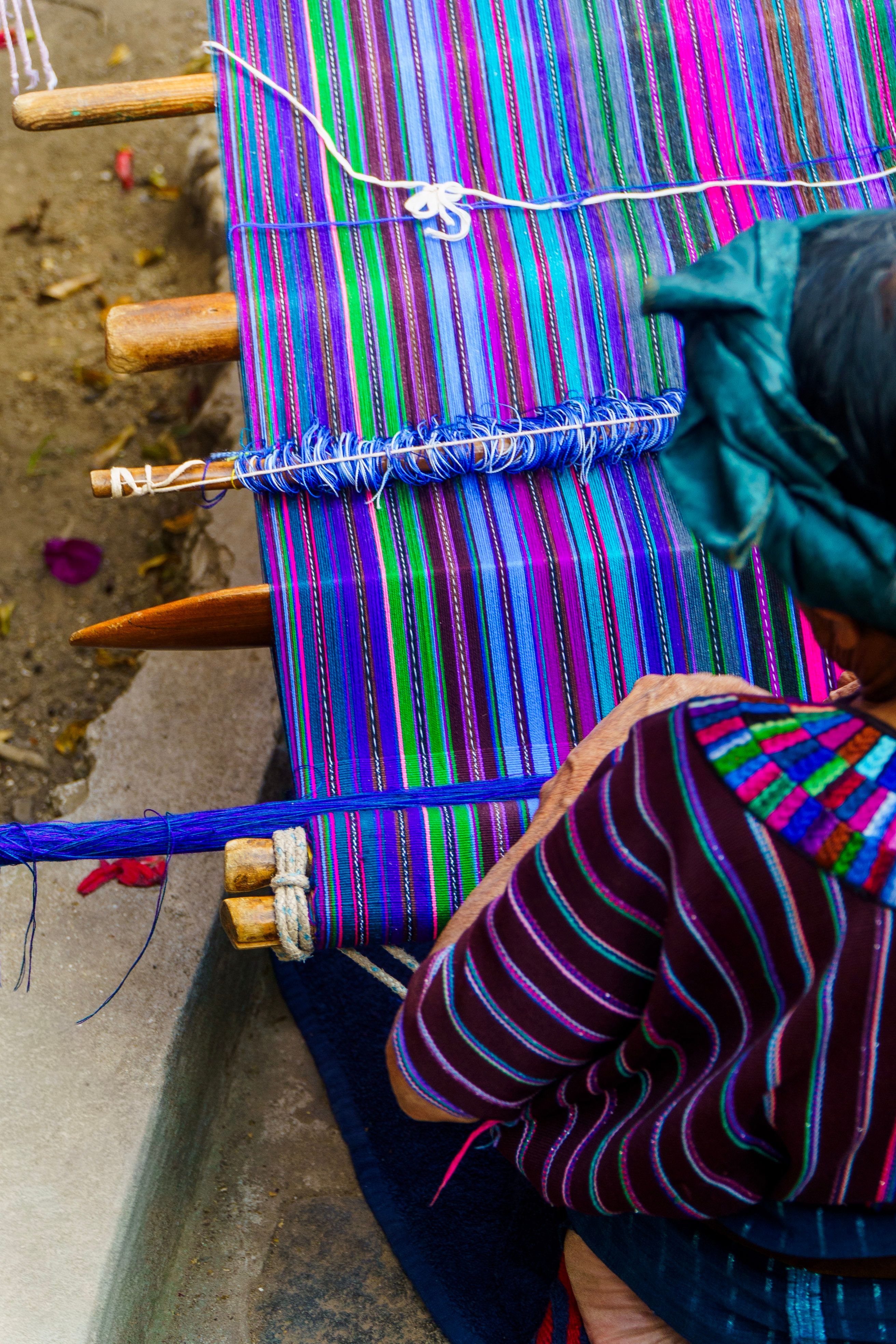
Traditional huipil cloth comes from a backstrap loom. The principle is simple. Two bars hold the warp threads. One is tied to a fixed point, the other to the weaver, by a strap that runs around her back. Leaning back puts the threads under tension. Leaning forward releases them, so she can lift threads and pass the weft through.
The loom is half tool, half body. That has a consequence: the width of the cloth is limited to how far the weaver can reach from side to side. Wider garments are therefore made from narrow panels joined together. The loom does allow many techniques, including pick-up patterns with extra threads and brocading, where coloured threads are carried into the weave to form a motif.
The Maxwell Museum of Anthropology reckons the Maya have been weaving on this loom for at least two thousand years. The Spanish brought the treadle loom, worked mostly by men, although that is changing; the backstrap loom stayed in use alongside it. In Maya cosmology the moon goddess Ix Chel guards weaving, childbirth and medicine, and the same museum reads the brocaded diamonds and zigzags as the weaver's relationship with the natural and the spiritual world.
A design as an address
Traditional huipils show which people and which community the wearer belongs to. Each community has its own designs for weaving and embroidery, and among Maya women the motifs on the front, back and shoulders indicate which village someone is from. For a long time it was uncommon, and often considered shameful, to wear a huipil with another community's design in your own village.
Besides the everyday huipil, women often own one for special occasions such as a wedding. In some Mesoamerican communities the wedding huipil is kept to be buried in. Ceremonial huipils belong to the cofradías, the brotherhoods that care for a saint. The wives of the officers wear one over their everyday huipil, and the Museo Ixchel in Guatemala City describes such dress as clothing that tells you a person's standing and office in the community.
A living tradition doesn't stand still. Weavers increasingly use commercially produced yarn, which widens the range of colours while the designs remain. At the same time, women's cooperatives in villages such as San Juan La Laguna, on Lake Atitlán, have revived dyeing with plants, bark and minerals.
Who owns a design
If a motif says where you come from, a question follows: who may use it? In May 2016 weavers, together with the women's association AFEDES from Sacatepéquez, went to Guatemala's Constitutional Court with a complaint against the state: there were no rules protecting their weaving. By February 2017 a bill was before Congress that would amend five articles spread across copyright law, industrial property law, the law on crafts and the penal code. They wanted recognition of the collective intellectual property of Indigenous peoples over their textiles and dress. Around thirty weaving associations from eighteen language communities stand behind the movement.
Their objection was to companies mass-producing their designs while the communities gained nothing. A spokeswoman for AFEDES pointed out that some elements of their clothing are sacred, and that others are worn only in ceremonies or by spiritual leaders. To them, a design is not decoration to be copied freely.
They also pointed to an imbalance. The state benefits from their work, they said, while the women who make the textiles still face discrimination. Anyone who buys a piece of weaving steps into that relationship, whether they intend to or not.
Looking and buying with respect
That background makes looking richer, and buying too. A few things we pass on to travellers. Ask before you photograph someone, even at a busy market. A huipil is a person's clothing, not a backdrop.
If you want to buy a huipil or a piece of weaving, it is best to buy directly from the weaver or from a cooperative. There you can ask who made it, which village the design comes from and how it was dyed. The answers give the piece more value than any label. A worn huipil has had a life with someone. Ask about it, and leave alone anything that looks ceremonial.
And take your time. A morning with a weaver who shows you how she sets up the warp tells you more about Guatemala than a bag full of souvenirs. In Santiago Atitlán, the Cojolya Weaving Center and Museum shows the history and process of backstrap weaving, and how Tz'utujil dress has changed over time.
Questions we are often asked
What is the difference between a huipil and a corte?
The huipil is the blouse, a loose tunic made from rectangular panels. The corte is the woven wraparound skirt. Together with the faja, the sash at the waist, they make up the traje, the traditional dress of Maya women.
How does a backstrap loom work?
One end is tied to a fixed point and the other to a strap around the weaver's back. Leaning back tightens the threads and leaning forward slackens them. As a result, the cloth can be no wider than the weaver can reach from side to side.
Why do women from different villages wear different huipils?
Because each community has its own designs, colours and lengths. The motifs on the front, back and shoulders show which village and which Maya people the wearer belongs to.
Is it OK for tourists to buy and wear a huipil?
Yes. Buy it directly from a weaver or cooperative if you can, ask which village the design comes from, and leave ceremonial pieces alone. Some motifs are sacred to communities or reserved for ceremonies.
Can I photograph weavers and women in traditional dress?
Always ask first. A huipil is someone's everyday clothing, and a conversation before the photo usually gives you more than the photo itself.
Further reading
More from the journal
Ryokan and onsen: staying and bathing the Japanese way
A ryokan is not a hotel with Japanese decor. On shoes and slippers, the yukata, washing before you bathe, tattoos, kaiseki, and why a stay like this is part of the journey.
Read more
Namibia's conservancies: when the wildlife belongs to the community
Since 1996, communities in Namibia have been able to form conservancies and earn from wildlife themselves. Today they cover a fifth of the country. On income, rhinos, lions and your stay.
Read moreAnd your trip?
From reading to a conversation.
What you read here is background, not an offer. Curious how a place like this fits into your trip? Tell us what you are looking for. That is where it starts.
Updated in October 2026