Journal
Gross National Happiness and what it means for visitors to Bhutan
In Bhutan, Gross National Happiness is a principle of government with its own article in the constitution. It explains the daily fee, the mandatory guide and the sixty per cent forest rule.
Gross National Happiness sounds like something printed on a poster. In Bhutan it is written into the constitution. Article 9 of the 2008 constitution states that the State shall strive to promote the conditions that enable the pursuit of Gross National Happiness. It is not a promise that everyone is happy. It is an instruction to those who govern.
For a traveller, this doesn't stay abstract. You pay a fee to the country for every night, you travel everywhere with a licensed guide, and you drive through valleys where most of the forest is still standing. These things are connected. They come from the same question Bhutan has been asking itself for half a century: what is growth worth if it consumes everything else?
A king who questioned GDP
The idea goes back to Jigme Singye Wangchuck, the fourth King of Bhutan, who put it forward in the early 1970s. He declared that Gross National Happiness is more important than Gross Domestic Product. A growing economy, on its own, says little about how well people live.
The Bhutanese government translates the idea into four pillars: sustainable and equitable socio-economic development, environmental conservation, the preservation and promotion of culture, and good governance. Beneath them sit nine domains. Some are what you would expect, such as health, education and living standards. Others are less usual in government policy: psychological wellbeing, time use, community vitality, cultural resilience and ecological diversity.
That list is worth keeping in mind as you travel through the country. Time, community and nature are not side issues next to the economy in Bhutan. They are measured too.
The idea did not stay within Bhutan's borders. On 19 July 2011 the United Nations General Assembly adopted, without a vote, resolution 65/309, which urges countries to measure happiness as a fundamental human goal. A year later resolution 66/281 of 12 July 2012 proclaimed 20 March the International Day of Happiness. The UN notes that the initiative came from Bhutan.
Happiness you can measure, and not everyone reaches
The Centre for Bhutan and GNH Studies built an index of 33 indicators spread across the nine domains, each weighted equally. Anyone who reaches sufficiency in at least two thirds of the weighted indicators counts as happy. In the 2022 survey of more than 11,000 people, 48.1 per cent of those aged fifteen and over fell into that group, up from 40.9 per cent in 2010.
That figure is more honest than the label Bhutan is often given. The country does not claim to be the happiest in the world. It measures where people fall short, so that policy knows where to act. According to the Oxford Poverty and Human Development Initiative, where the measurement method was developed, that is exactly what the index is for: setting priorities and tracking progress alongside GDP.
The Lhotshampa, in those same years
Gross national happiness took shape in the years in which Bhutan lost a large part of its Nepali-speaking population. The Lhotshampa live in the south of the country. The Citizenship Act of 1985 tightened the conditions for being Bhutanese, and a census held in 1988 in the south alone recorded tens of thousands of them as non-nationals. In 1989 a cultural code was added: Drukpa dress and manners became compulsory and Nepali disappeared from the schools. Human Rights Watch described what followed in reports in 2003 and 2007. People were expelled or left to escape harassment, abuse and imprisonment, and many had to sign a form stating that they were going of their own free will.
By mid-1994 some 86,000 of them were living in camps in eastern Nepal. By 2007 there were 108,000, spread across seven camps in the Jhapa and Morang districts. What came next was not return but resettlement: between 2007 and 2015 more than 100,000 people left for eight countries, almost 85,000 of them to the United States. Two camps remained, with people who are still waiting.
This is not what a traveller sees today, and it belongs to the story all the same. A country that makes happiness a principle of government carries this in its history too.
High value, low volume
Tourism is where the principle shows most clearly. Bhutan first admitted foreign visitors in 1974, and when the country reopened after the pandemic in September 2022, the Prime Minister said the High Value, Low Volume policy had existed since that start. He added something often misunderstood: low volume does not mean limiting the number of visitors. The point is the value of each visit, for the guest and for the country. There is no quota: the World Bank series shows how fast it grew, from 155,000 visitors in 2015 to 316,000 in 2019, the busiest year up to then.
That value takes shape in the Sustainable Development Fee, a levy every visitor pays per night when applying for a visa. It goes to the national exchequer. Article 14 of the constitution requires all taxes, fees and levies to be deposited into a single Consolidated Account. From there, according to the Department of Tourism, the money funds free healthcare, education and training, upskilling in tourism and hospitality, infrastructure, environmental conservation, cultural preservation and local businesses. The department also lists schools, drinking water, forests and wildlife, and the renovation of historic dzongs.
Something else changed at that reopening. Visitors no longer have to travel through a licensed tour operator. You can apply for a visa online yourself.
Sixty per cent forest, for all time
Article 5 of the constitution deals with the environment. It calls every Bhutanese a trustee of the kingdom's natural resources, for present and future generations. Its third section states that a minimum of sixty per cent of Bhutan's total land shall be maintained under forest cover for all time.
That is a floor, not a target. Actual forest cover is higher: 71.4 per cent in 2020, according to the World Bank. And more than half the country is protected. The World Database on Protected Areas, kept by UNEP-WCMC and the IUCN, puts it at 51.6 per cent, nearly twenty thousand of the country's almost thirty-nine thousand square kilometres, across twenty-three protected areas. The Department of Tourism describes the visitor fee as one of the means of maintaining that forest cover and the country's carbon neutrality.
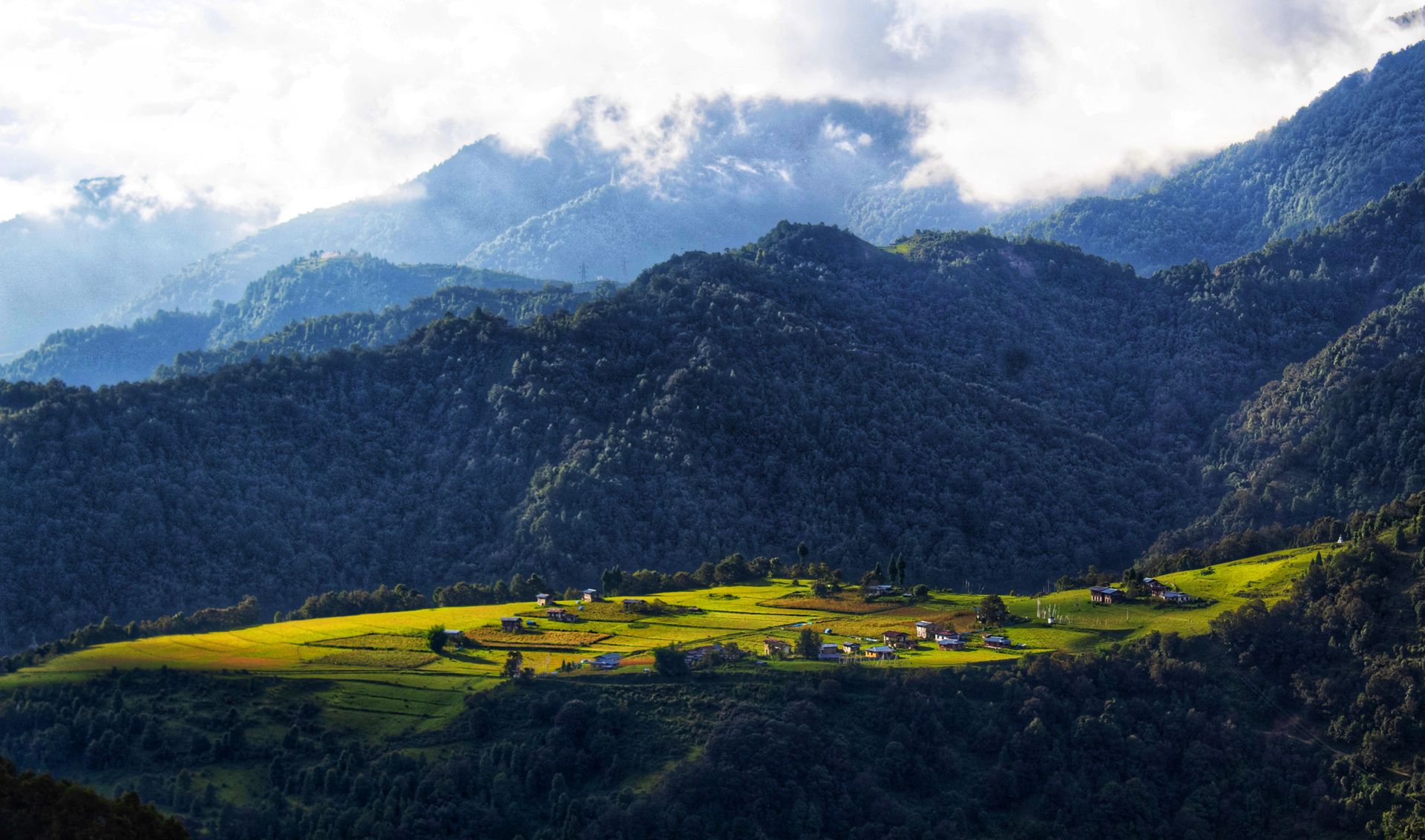
For a traveller, that means a country where forest is the rule and open ground the exception. It is not an accident of geography. It is a choice written into the highest law.
What it means when you go
A licensed guide accompanies you at all times. That is the Department of Tourism's rule, and you also need your guide to enter dzongs and monuments. Treks are done with an accredited tour operator or guide. Self-drive car hire isn't possible, so you travel with a driver.
The guide is more than an obligation. This is the person who explains what you are looking at inside a dzong, and who translates the conversations you have along the way. In a country that shapes its policy around time, community and nature, that conversation is how you come to understand what you are seeing.
There is no dress code for visitors, although for religious sites the Department of Tourism asks for smart clothing that covers you from shoulders to knees. Our advice: choose fewer places and give each one more time, so the conversations with your guide have room to breathe.
Questions we are often asked
Is Bhutan really the happiest country in the world?
Bhutan doesn't claim that. It measures happiness with its own index of 33 indicators. In the 2022 survey, 48.1 per cent of people aged fifteen and over were classed as happy, compared with 40.9 per cent in 2010. The index is mainly used to see where policy falls short.
Where does Bhutan's daily fee go?
To the national exchequer, and from there to projects such as free healthcare, education and training, infrastructure, conservation of nature and culture, and local businesses. According to the Department of Tourism it also helps maintain the country's forest cover and carbon neutrality.
Can you travel around Bhutan without a guide?
No. According to the Department of Tourism a licensed guide must accompany you at all times, including when entering dzongs and monuments. Self-drive car hire isn't available either.
Do you need a tour operator to get a visa for Bhutan?
No, not since the reopening on 23 September 2022. You can apply for the visa online yourself and pay the fee at the same time. A tour operator or hotel can also apply on your behalf.
How much of Bhutan is forested?
Around 71 per cent in 2020. The 2008 constitution sets a minimum of sixty per cent, for all time.
Further reading
More from the journal
Ryokan and onsen: staying and bathing the Japanese way
A ryokan is not a hotel with Japanese decor. On shoes and slippers, the yukata, washing before you bathe, tattoos, kaiseki, and why a stay like this is part of the journey.
Read more
The huipil: how a Guatemalan village speaks through thread
In the Guatemalan highlands, a huipil tells you where a woman comes from. On backstrap weaving, designs that belong to a community, and what visitors should and shouldn't do.
Read moreAnd your trip?
From reading to a conversation.
What you read here is background, not an offer. Curious how a place like this fits into your trip? Tell us what you are looking for. That is where it starts.
Updated in October 2026