Journal
Namibia's conservancies: when the wildlife belongs to the community
Since 1996, communities in Namibia have been able to form conservancies and earn from wildlife themselves. Today they cover a fifth of the country. On income, rhinos, lions and your stay.
Shortly after independence in 1990, the then ministry responsible for wildlife and a group of NGOs went into rural areas with a simple question: what do people living on communal land want? The answer was clear. They wanted the same rights as farmers on freehold land, who could hunt game and set up tourism businesses on their property.
In 1996 the Nature Conservation Ordinance of 1975 was amended. The change gave communities rights over the natural resources on their land, wildlife included, and the right to develop tourism there. They exercise those rights through communal conservancies. The first four were registered in 1998: Nyae Nyae, Torra, Salambala and ≠Khoadi-//Hôas. By the end of 2023 there were 86, together covering more than 166,000 square kilometres, or 20.2 per cent of Namibia, with around 244,600 residents.
It fits a country whose 1990 constitution directs the state to maintain ecosystems and biological diversity and to use living natural resources sustainably, for the benefit of all Namibians, present and future.
How a conservancy works
A conservancy is not a fenced park. It is a self-governing organisation of the people who live in an area, recognised by the Ministry of Environment, Forestry and Tourism. Each has its own constitution and elects a management committee. Residents go on living there and keeping their livestock.
To stay compliant, a conservancy has to meet a set of standards: hold an annual general meeting, distribute benefits according to a benefit distribution plan, report in line with a game management and utilisation plan, and present annual financial reports. In 2023, 767 game guards worked in conservancies, and 54 conservancies carried out annual game counts. Women hold 35 per cent of management committee seats and 47 per cent of treasurer or financial manager posts, although only 12 per cent of chairpersons are women.
It does not always run smoothly. The 2023 annual report describes conservancies where elections were not held, funds went unaccounted for, or members lodged complaints. That such problems are reported openly is part of the model too.
Where the income comes from
Tourism is the biggest source. Conservancies enter joint ventures with lodges: a private company builds and runs the lodge, the conservancy receives a fee, and residents get jobs. In 2023 there were 74 such agreements, employing 934 full-time staff between them. Tourism accounted for around two thirds of all conservancy income and benefits that year.
The second source is hunting. There were 57 conservation hunting concessions, and in 2023 residents received more than 90,000 kilograms of game meat. On top of that come smaller earnings from crafts and plant products. In the northwest, for example, a trust run by five conservancies processes resin from indigenous plants into essential oils. Altogether, community conservation facilitated 2,340 jobs in 2023, of which 1,057 were directly with conservancies.
Doro !nawas, in Kunene, shows what that looks like in one place. The conservancy was gazetted in 1999 and has around 1,500 residents, mostly Damara, who depend largely on small livestock. It has four tourism enterprises, including a community-run campsite. The newest lodge, a nine-room joint venture, opened in June 2021. Sixty per cent of its 34 staff come from the conservancy, and the lodge supports, among other things, rhino rangers' salaries, water points for elephants and a village garden.
The pandemic exposed the weak spot. When international tourism stopped, much of the income went with it. Since then conservancies have deliberately looked for a wider range of income sources.
What it has done for wildlife
According to the 2023 annual report, wildlife numbers have increased since 1990, although drought in the northwest has caused recent declines. Namibia's elephant population grew from around 7,600 in 1995 to around 23,600 in 2016, according to aerial surveys.
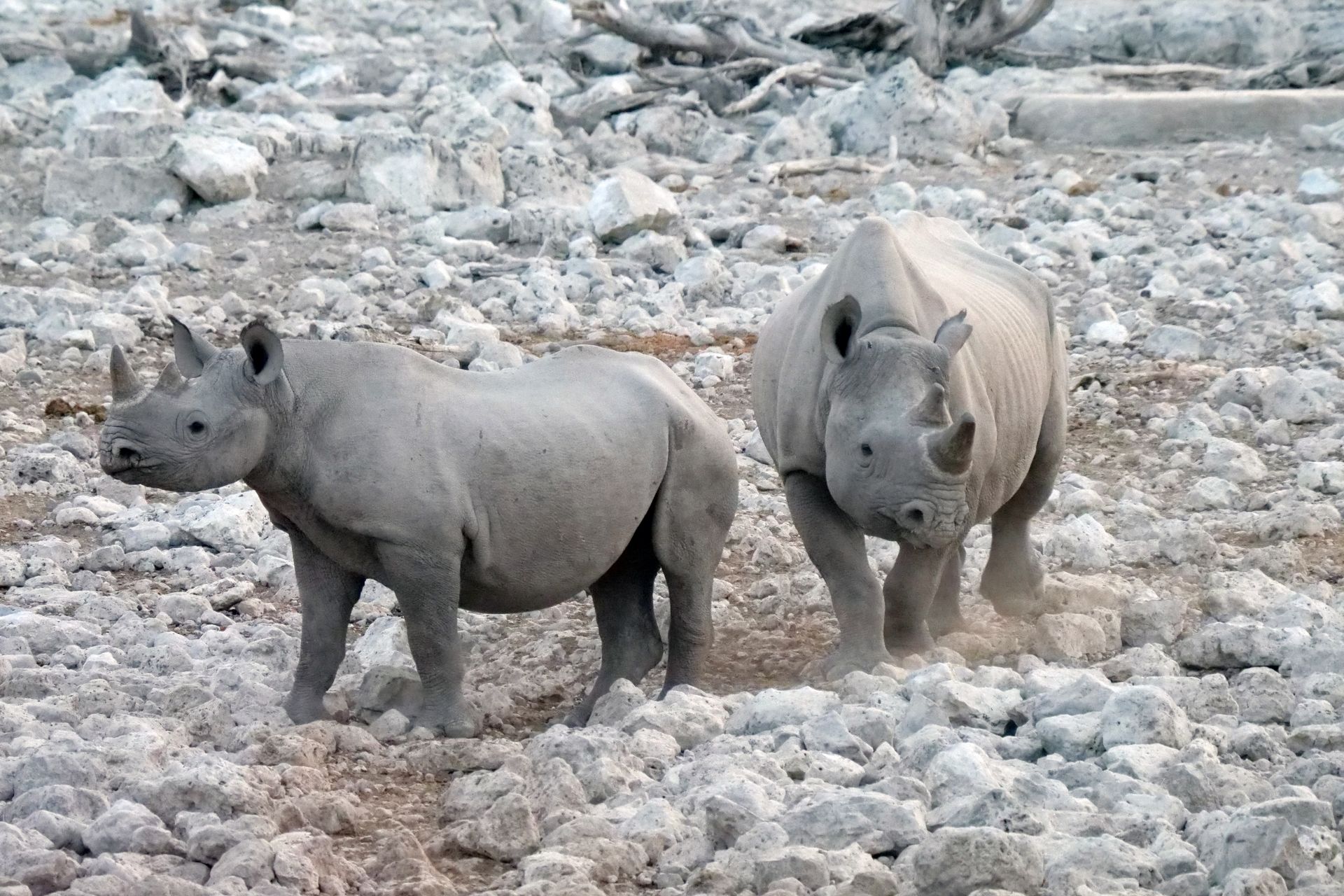
For the black rhino the story stands out. Namibia has the largest free-roaming black rhino population in the world. In 2023, 69 rhinos were poached in the country, down from 97 in 2022, but none in conservancy areas. Rhino rangers from the communities monitor the animals. In Doro !nawas, a lodge helps pay their salaries.
The lions: the honest version
With lions it is harder. Between November 2022 and January 2023 the ministry carried out the first systematic survey of the free-ranging lions of the northwest, working with lion rangers, the Namibian Lion Trust and the NGO IRDNC. The core range of around 40,000 square kilometres takes in eleven conservancies, including Torra and Doro !nawas. The teams found 57 to 60 adult lions and 14 cubs.
That is fewer than earlier estimates. The main cause lies with their prey, which fell by 53 to 85 per cent after years of drought. With less prey, lions turn to livestock more often, and conflict with herders is the main cause of lion deaths in the area. Some prides even went looking for food along the coast.
Living with lions, elephants and leopards costs farmers livestock and crops. Some conservancies therefore set aside part of their income for their own scheme to compensate for damage caused by wildlife. The model does not resolve that conflict, but it gives the people who bear the costs a share of the benefits as well.
What it means when you stay there
Staying at a lodge or camp inside a conservancy puts you in the middle of that model. Part of what your stay brings in goes to the conservancy as a fee, and a large share of the staff often comes from the area. You share the landscape with the people who manage it. Livestock and herders belong there as much as the wildlife does.
Feel free to ask how your lodge is connected to the conservancy. Is it a joint venture, a community-owned business, or a private lodge on a concession? The answer says a lot about where your contribution ends up. And make time for what sets a conservancy apart from a park: a walk with someone who knows the area, or a morning looking for rhinos with an outfit that takes visitors out for that, such as the one in Torra.
Travel this way and you see that conservation in Namibia is not a matter of a fence and a ticket. It is an agreement between people and animals who have to live on the same dry land.
Questions we are often asked
What is a communal conservancy in Namibia?
A self-governing area on communal land where, since a change in the law in 1996, residents hold rights over wildlife and can run tourism and hunting. Each conservancy has a constitution, an elected management committee and a plan for distributing benefits.
How many conservancies are there in Namibia?
At the end of 2023 there were 86, covering 20.2 per cent of the country, with around 244,600 residents. The first four were registered in 1998.
How do communities make money from a conservancy?
Mainly through tourism, via joint ventures with lodges, and through hunting, which also provides game meat. There are also crafts, plant products and jobs as game guards or rangers.
Are rhinos poached in the conservancies?
Not in 2023. Namibia recorded 69 poached rhinos that year, but according to the State of Community Conservation report none were in conservancy areas. The country has the largest free-roaming black rhino population in the world.
Does staying in a conservancy actually help?
Yes, if your lodge has an agreement with the conservancy. In 2023 tourism accounted for around two thirds of conservancy income and benefits, through fees, wages and support for projects. Ask how your lodge is linked to the community.
Further reading
More from the journal
Ryokan and onsen: staying and bathing the Japanese way
A ryokan is not a hotel with Japanese decor. On shoes and slippers, the yukata, washing before you bathe, tattoos, kaiseki, and why a stay like this is part of the journey.
Read more
The huipil: how a Guatemalan village speaks through thread
In the Guatemalan highlands, a huipil tells you where a woman comes from. On backstrap weaving, designs that belong to a community, and what visitors should and shouldn't do.
Read moreAnd your trip?
From reading to a conversation.
What you read here is background, not an offer. Curious how a place like this fits into your trip? Tell us what you are looking for. That is where it starts.
Updated in October 2026